


Healthcare-associated infections are the gravest threat to patient safety in hospitals worldwide1. By establishing infection prevention and control(IPC) teams and programs, hospitals can decrease healthcare-associated infections by at least 30%2, and improving staff hand hygiene compliance can reduce them by half3. When it was launched in 20054, the main objective of the World Health Organization(WHO) First Global Patient Safety Challenge: Clean Care is Safer Care was to make IPC a global priority in health care, with hand hygiene assessment and improvement as the central component.
In 2019, healthcare facilities and IPC leaders are invited to take part in the WHO 2019 Global Survey and to use validated assessment instruments: the Infection Prevention and Control Assessment Framework(IPCAF) and the Hand Hygiene Self-Assessment Framework(HHSAF)5. These two simple and systematic diagnostic tools allow healthcare facilities to obtain a situational analysis of IPC and hand hygiene activities, and help identify key issues that require attention in their respective institutions. The IPCAF survey supports the implementation of the WHO Guidelines on core components of IPC programs at the acute healthcare facility level6. The HHSAF is divided into five components that reflect the five elements of the WHO Multimodal Hand Hygiene Improvement Strategy7. The understanding that hand hygiene practices are a central part of IPC has become recognized globally over the past few decades, but this change cannot be taken for granted. Even the idea of defining an array of diseases as healthcare-associated infections and addressing healthcare-associated infections as a preventable condition required a paradigm shift and a new way of thinking.
A shift in thinking
This shift had its origins in the mid-19th century. Ignaz Semmelweis was one of the main pioneers of improved IPC practices and is regarded as the father of hand hygiene. As an obstetrician at the Vienna General Hospital, he proved that scrubbing hands with a chlorinated lime solution before contact with a patient drastically decreased mortality due to puerperal fever among women giving birth in the hospital8. He published his discovery, but his ideas unfortunately remained unpopular9. A few years later, the French chemist and microbiologist, Louis Pasteur, showed that microorganisms were the cause of some infectious diseases. He also helped confirm that a contaminated environment could be responsible for germ transmission10,11. Subsequently, the health community had to wait for more than a century for any new breakthroughs in the fight against healthcare-associated infections. In the 1970s and the 1980s, the United States Centers for Disease Control and Prevention(CDC) recognized handwashing as “the most important procedure in preventing nosocomial infections”, and the first national hand hygiene guidelines were subsequently published in 198312.
One hospital model disseminated worldwide
In the mid-1990s, researchers at the University of Geneva Hospitals and Faculty of Medicine demonstrated that promoting hand hygiene through the use of alcohol-based handrub at the point of patient care, instead of soap and water handwashing, was revolutionary for decreasing healthcare-associated infections and reducing methicillin-resistant Staphylococcus aureus cross-transmission rates3. The ‘Geneva model’ for hand hygiene promotion, published in The Lancet in 20003, drew the attention of the entire IPC community, and began to be implemented in healthcare facilities worldwide13. This model was the precursor of the WHO Multimodal Hand Hygiene Improvement Strategy, which was published in its current format in 2009.13 In 2005, in order to create a global momentum for the adoption of hand hygiene worldwide, the WHO integrated hand hygiene as the central part of its Clean Care is Safer Care campaign14. Since then, many tools and initiatives have been developed by WHO to facilitate the implementation of this patient safety intervention at local and national levels, regardless of IPC expertise or resource setting.
From scientific evidence to daily practice
To bridge the gap between scientific evidence and daily care practice, WHO and the WHO Collaborating Centre on Patient Safety at the University of Geneva Hospitals and Faculty of Medicine developed My Five Moments for Hand Hygiene15. This tool designates key moments when hand hygiene is required to avoid pathogen cross-transmission. The concept, described as a time-space framework, provides a solid basis to understand, teach, monitor and report hand hygiene practices. However, the task of cleaning hands at the right times and in the right way is deceptively simple, and remains difficult to implement successfully15,16.
The WHO Multimodal Hand Hygiene Improvement Strategy promotes and facilitates optimal hand hygiene implementation. It includes five key components : (1) system change (i.e., the systematic recourse to alcohol-based handrubbing instead of handwashing with soap and water), (2) staff training and education, (3) evaluation and feedback, (4) reminders in the workplace, and (5) promotion of an institutional safety climate17. To facilitate system change and make access to alcohol-based handrub universal, the WHO Collaborating Centre for Patient Safety in Geneva developed and tested two alcohol-based handrub formulations suitable for local production in low-resource settings18. WHO studied the implementation of the multimodal strategy in a quasi-experimental study in six countries worldwide, and proved its feasibility and sustainability across a range of settings with different cultures and economic resources13. Based on scientific evidence, an updated version of the WHO Guidelines on Hand Hygiene in Health Care was published in 2009, with a strong focus on the hand hygiene multimodal promotion strategy. That same year, WHO launched the annual SAVE LIVES: Clean Your Hands campaign that culminates on World Hand Hygiene Day, on and around May 5th of each year. This worldwide initiative promotes a large series of activities and tools, and is currently providing coordination and support to more than 21,000 facilities in 182 countries19,20.
The Hand Hygiene Self-Assessment Framework: a practical tool to lead the fight
The momentum to combat healthcare-associated infections through improved hand hygiene continues in a universal perspective with the WHO 2019 Global Survey5 and with the third worldwide launch of the HHSAF survey. The major benefit of using such a tool is that it facilitates comparison between facilities and regions, and, when used sequentially over years, allows facilities to assess progress made over time21. The framework is aimed at tracking the level of progress of health facilities in the context of implementation, as well as continued improvement. It is divided into five parts related to the five components of the WHO multimodal strategy, and it includes a set of 27 indicators to assess the state of facilities’ hand hygiene promotion programs7. The HHSAF has been made available to health facilities since 2010. It quickly proved to be easy to use and useful for assessing the facility level with regard to hand hygiene promotion22.
Recent studies have demonstrated the usefulness of the HHSAF in developing a regional or national action plan to improve hand hygiene practices within healthcare facilities. In the USA, a national survey allowed hospitals to assess the level of implementation of the WHO strategy across the country for the first time23 .In Greece, using a cross-sectional national survey, researchers were able to quantify the impact of IPC nurse staffing levels on the HHSAF score per key element. It also helped facilities benchmark their results against comparable international data24. In Italy, regional surveillance in Piedmont revealed critical issues concerning the lack of active involvement in hand hygiene activities by patients, family members and caregivers25. Two hand hygiene global surveys were conducted by WHO in 2011 and 2015, showing a snapshot of the current position of hand hygiene implementation and significant improvements in participating facilities across all WHO regions21. Still, the analysis of regular monitoring and reporting of the WHO multimodal improvement strategy through the use of the HHSAF remains scarce in the literature. The more hospitals take part in completing this self-assessment tool, the more data will be available to compare results, performances and attitudes in different regions. The data provided by this questionnaire is an ideal source to design a regional strategy for hand hygiene promotion; the tool is freely available at: https://www.who.int/ gpsc/5may/hhsa_framework/en/7.
2019 WHO calls to actions
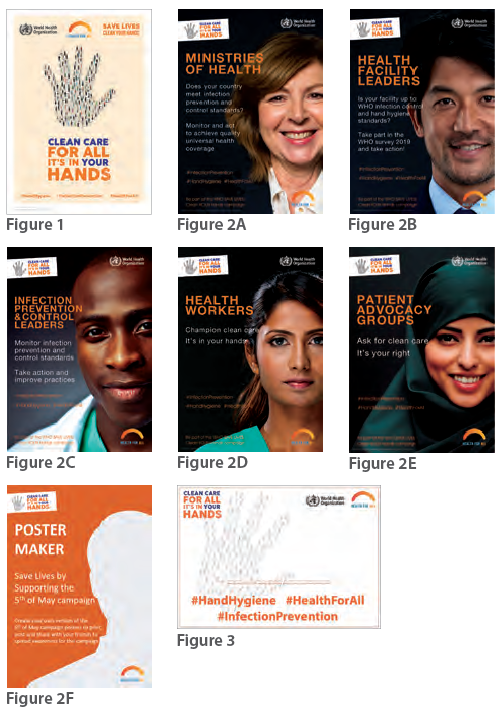
The WHO 2019 theme for hand hygiene reflects a strong focus on providing clean care equally protecting all patients and healthcare workers from infection and antimicrobial resistance transmission, across all countries, including in low-resource settings: Clean Care for All - It’s In Our Hands! (Figure 1).
WHO urges ministries of health (Figure 2A), health facility leaders (Figure 2B), IPC leaders (Figure 2C), health workers (Figure 2D), and patient advocacy groups (Figure 2E) to contribute to effective IPC action, including hand hygiene as a cornerstone of quality in healthcare (Table 1). WHO invites all healthcare facilities and countries to ask their own representatives and leaders to prepare their own posters using the pre-prepared posters to facilitate implementation (Figure 2F, see also instructions at http://www.CleanHandsSaveLives.org/).
WHO invites everyone to pledge for “Clean Care for All; it’s in your hands”. You can participate by sending your photos and selfies made together with your colleagues, collaborators, patients, relatives, and friends from all over the world. The 2019 board is shown in Figure 3. Sign your name and ask your friends and colleagues, as well as patients and their relatives, to do the same. Please note that the hashtags are: #HandHygiene, #HealthForAll and #InfectionPrevention. You can submit your photos of the board at http://www.CleanHandsSaveLives.org/.
IPC, including hand hygiene, is critical to achieve universal health coverage, as it is a practical and evidence-based approach with demonstrated impact on quality of care and patient safety across all levels of resources and health systems. Let’s all monitor the capacity of promoting hand hygiene in our institution and participate in the global momentum to improve patient safety. “Clean Care For All – It's In Your Hands”!
| Table 1. May 5, 20219, World Health Organization SAVE LIVES: Clean Your Hands campaign call to action | |
| Campaign participants | Call to action |
| Health workers | "Champion clean care - it's in your hands." |
| IPC* leaders | "Monitor infection prevention and control standards - take action and improve practices." |
| Health facility leaders | "Is your facility up to WHO infection control and hand hygiene standards? Take part in the WHO survey 2019 and take action!" |
| Ministries of Health | "Does your country meet infection prevention and control standards? Monitor and act to achieve quality universal health coverage." |
| Patient advocacy groups | "Ask for clean care - it's your right." |
| *IPC, infection prevention and control | |
Acknowledgment
This work is supported by the World Health Organization (WHO), Geneva, Switzerland, and the Infection Control Programme and WHO Collaborating Centre on Patient Safety (SPCI/WCC), University of Geneva Hospitals and Faculty of Medicine, Geneva, Switzerland; hand hygiene research activities at the SPCI/WCC are also supported by the Swiss National Science Foundation (grant no. 32003B_163262). Didier Pittet works with WHO in the context of the WHO initiative Private Organizations for Patient Safety – Hand Hygiene. The aim of this WHO initiative is to harness industry strengths to align and improve the implementation of WHO recommendations for hand hygiene in healthcare in different parts of the world, including in least developed countries. In this instance, companies/industry with a focus on hand hygiene and infection control-related advancement have the specific aim of improving access to affordable hand hygiene products, as well as through education and research. All listed authors declare no financial support, grants, financial interests, or consultancy that could lead to conflicts of interest. The authors alone are responsible for the views expressed in this article, and they do not necessarily represent the views, decisions, or policies of the institutions with which they are affiliated. WHO takes no responsibility for the information provided or the views expressed in this paper.
-
Publication Date:February 28, 2020
-
Category:Hand Hygiene
HosCom International 2020 Vol. 1
