


About the Event
The inaugural Healthcare Environmental Hygiene Train-the-Trainers (HEHTTT), led by Professor Didier Pittet and his team of experts, took place in Malaysia from January 23rd to 24th, 2024. Saraya Co., Ltd. and Saraya Goodmaid Sdn. Bhd. supported this event. It served as a two-day platform, attracting 160 participants comprising health experts, hospital administrators, engineers, and infection prevention and control personnel from across Malaysia, all attending to receive training as future trainers.
Throughout the program, discussions centered on proper hospital cleaning and maintenance of its surroundings, with a focus on commonly overlooked areas. The sessions also introduced the best cleaning techniques and recommended tools. Additionally, topics included air change rates and strategies for maintaining optimal ventilation in patient areas. An integral part of the HEHTTT was the introduction of the Healthcare Environment Hygiene Self-Assessment Framework (HEHSAF) tool. Developed and internationally validated, HEHSAF aids healthcare facilities in identifying areas for improvement within their environmental hygiene programs. Overall, the HEHTTT aimed to raise awareness, foster discussions on best practices, and explore the latest scientific research regarding the impact of proper environmental conditions on infection prevention and control in hospitals.

The speaker team comprises Dr. Andreea Capilna, Ms. Martina Mocenic, Professor Didier Pittet, Dr. Pamela Lee Yew Fong, and Professor Sasheela Ponnampalavanar, as depicted from left to right. These experts were present to engage with participants, sharing insights from their current practices and suggesting evidence-based improvements for implementation in their facilities.
Day 1 (Theory and Discussion)
As early as 8:00 am, 160 participants from across Malaysia arrived at NIH to register and take their seats, eagerly anticipating the start of the session.
Professor Didier Pittet commenced the program with his first session titled "From Clean Hands to Clean Hospitals." During this session, he elaborated on the Clean Hands program and its success in improving hand hygiene rates among healthcare workers, consequently reducing treatment costs significantly by minimizing healthcare-associated infection (HAI) rates and duration of hospital stay. The concept of Clean Hospitals represents the evolution of Clean Hands, shifting the focus from hands alone to encompassing the entire healthcare facility environment. By broadening the scope to include hospital surroundings, Clean Hospitals has the potential to further reduce HAI, recognizing that disease contamination is not limited solely to hands but extends to the hospital environment as well.
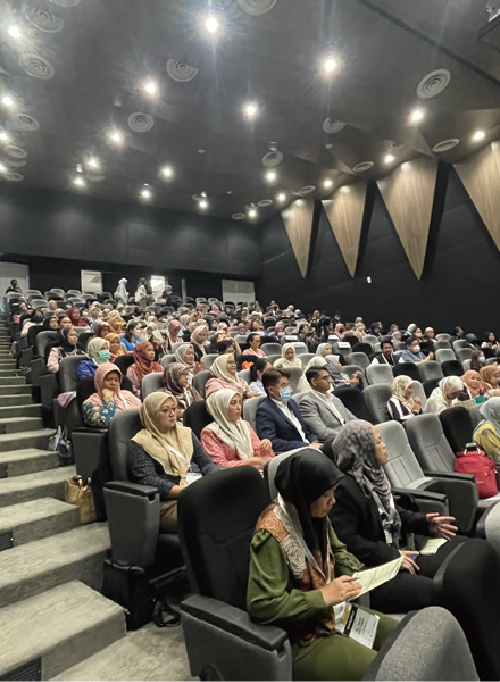
Following the opening session, participants were tasked with completing the Clean Hospitals HEHSAF to assess their baseline knowledge prior to the HEHTTT. At the conclusion of the 2-day program, participants were asked to revisit the HEHSAF to reassess the knowledge they had acquired.
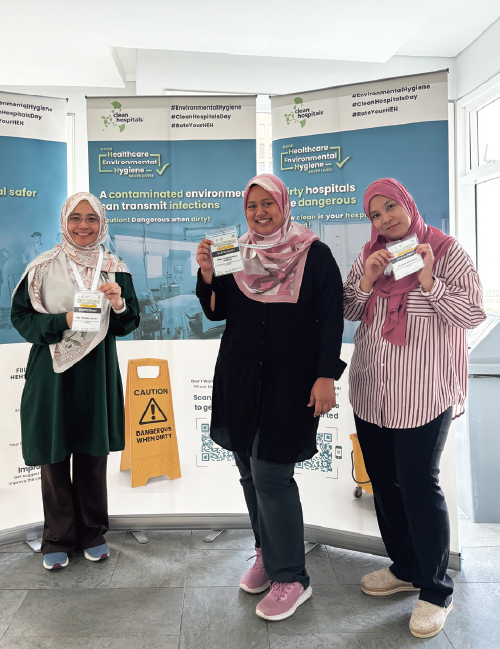
Additionally, digital copies of Clean Hospitals marketing materials, such as banners and posters, were distributed during the HEHTTT. These materials were intended for participants to take home and reproduce in their facilities, thereby promoting the Clean Hospitals initiative within their respective healthcare environments.
Day 2 (Practical Session and Discussion)
The second day commenced with a continuation of the discussions from the first day, providing participants with a cohesive learning experience before they proceeded to the practical sessions.
All 160 participants were divided into 8 groups, each consisting of 20 members, to initiate the practical sessions. Subsequently, the 8 groups were further divided into 4 pairs, with 2 groups in each pair, before rotating within the practical session. There were 4 areas of focus during this HEHTTT, namely:
Bathroom Station – During this activity, trainers shared the best cleaning techniques for thorough cleaning, while also highlighting commonly missed areas during routine cleaning with group participants. Trainers stained areas with UV gel before participants proceeded with cleaning. Following the cleaning, trainers utilized UV black light to reveal commonly missed areas. In addition to identifying missed areas, participants compared wiping techniques to determine the most effective method for leaving little to no residue.
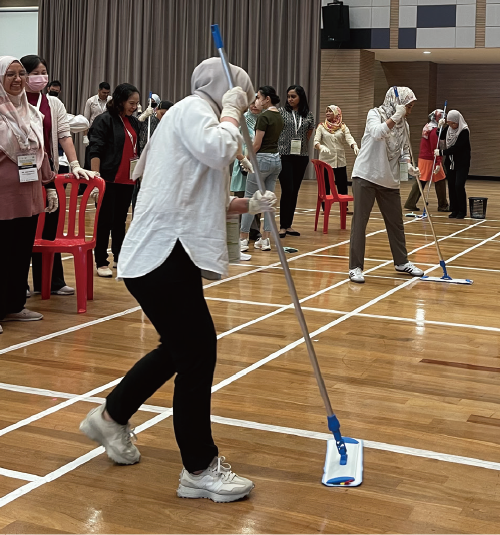
Floor Station – Trainers introduced the benefits of flat mops compared to conventional mops. Additionally, they demonstrated the correct technique for using a flat mop and allowed participants to experience first-hand how flat mops outperformed conventional mops.
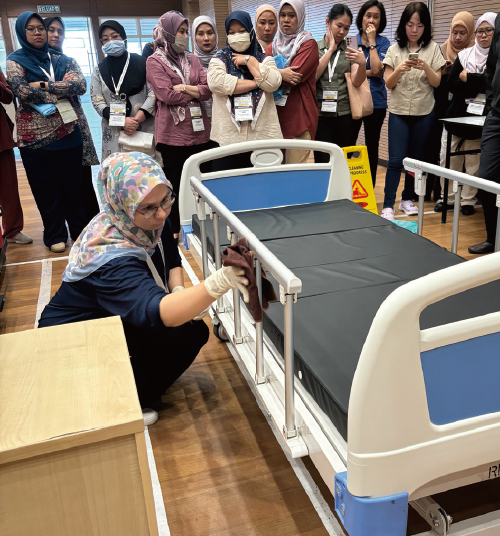
Bed & Surface Station – Trainers began by staining the area with UV gel before participants entered the designated areas. Participants were then tasked with cleaning these areas, with trainers using UV black light to identify commonly missed spots after the cleaning process. Throughout this session, the concept of "clean to dirty" was emphasized, meaning that surfaces should be cleaned in sequence from clean to dirty to prevent cross-contamination.
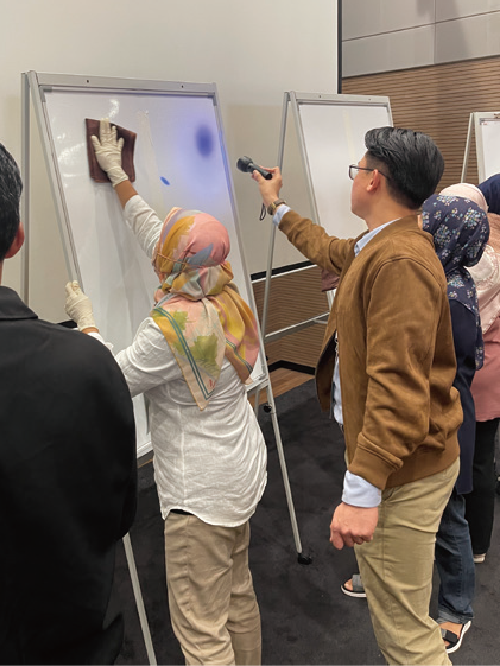
Contamination Station – In this particular station, trainers applied UV gel to stain the whiteboard before instructing participants to clean it using a cloth. Trainers then used UV black light to demonstrate how the conventional circular motion wiping technique left behind residue, prompting a discussion on the most effective wiping techniques.
Conclusion
After two full days of HEHTTT, supported by the Malaysia Ministry of Health, Professor Didier Pittet and his team, along with Saraya Co., Ltd. and Saraya Goodmaid Sdn. Bhd., we have successfully equipped the 160 healthcare participants from across Malaysia with enhanced knowledge and ideas for improving hospital environmental hygiene. They have gained a deeper understanding of the importance of this aspect and are better equipped to implement effective strategies in their respective healthcare facilities.
-
Publication Date:October 04, 2024
-
Category:Environmental Management
HosCom International 2024 Vol. 2
