


Introduction
About 14 million endoscopic interventions are carried out in Russia annually, and a few scores of related healthcare-associated infection (HAI) cases are officially registered. The Epidemiological Safety System (ESS) for endoscopic interventions and the method of safety level detection in a particular medical organization have been determined in the country.
Since September 1, 2021, the third version of the national guidelines for ensuring the epidemiological safety of endoscopic examinations [1] (hereinafter referred to as the Guidelines) has been in effect in Russia. The release of this document was preceded by a recurrent survey conducted in 2019, which was completed by 460 doctors and nurses representing endoscopy hospital departments from 80 regions of Russia. The survey contained 47 questions, some of which were not answered by all respondents.
We set ourselves the task of assessing the main risk factors for patient infection during endoscopic examinations to correct the requirements for individual components of the ESS for endoscopic interventions and to control the quality of flexible endoscope reprocessing.
Survey Results
A comparison of the results of questionnaires from 2006, 2014, and 2019 revealed an increase in the annual number of endoscopic interventions, including surgical ones. In 2006, in endoscopy departments, endoscopy examinations were performed an average of 7 times per day. In 2014, there were 15 examinations per day. In 2019, more than 15 examinations per day were carried out by 70% of the surveyed hospitals. Surgical interventions in 2019 were performed in 303 (66.3%) endoscopy departments.
The infectious safety of endoscopes is ensured by the correct operation of reprocessing and compliance with the requirements of the Guidelines. The analysis of the materials obtained from the period 2006-2019 indicates that the system of reprocessing, including technical equipment and material support, is steadily improving. Of the 460 endoscopy departments, 385 (73.7%) have reprocessing rooms. The area for manual cleaning is organized correctly. Reprocessors (EWDs) are used by 300 (65.2%) out of 460 hospitals that were surveyed. In 2014, the use of EWD equipment was extremely low, amounting to only 22.6% of hospitals.
 Disinfectant solutions for manual cleaning of endoscopes prepared on a daily basis are used by 47.4% of hospitals. Single-use detergents based on surfactants are used in 8.7% of endoscopy departments, and with an enzymatic booster, 27.0% of endoscopy departments. The share of ineffective detergents or disinfectants for endoscope cleaning fell from 26% in 2014 to 16.9% in 2019.
Among the high-level disinfection (HLD) chemicals applied, the aldehyde share is 47.9%, 38.7% use peracetic acid (PAA), and the remaining 13.4% use HLD solutions not recommended for such a purpose. There is a tendency to replace detergent and HLD solutions for EWD with cheaper counterparts without their validation in EWDs. More than a third of endoscopy departments do not check the minimum effective concentration of HLD solutions. The main reasons why test strips are not used are that chemical indicators are not developed for the product (10.5% of hospitals) or that they are not purchased (23.7% of hospitals).
Two-stage cleaning (pre-cleaning and manual cleaning) of endoscopes is extremely important to ensure the effectiveness of the subsequent HLD procedure. Among 442 surveyed endoscopy departments, 325 (73.5%) never violate the guidelines for manual cleaning. The analysis showed a low incidence of critical errors during pre-cleaning and manual cleaning (Table 1).
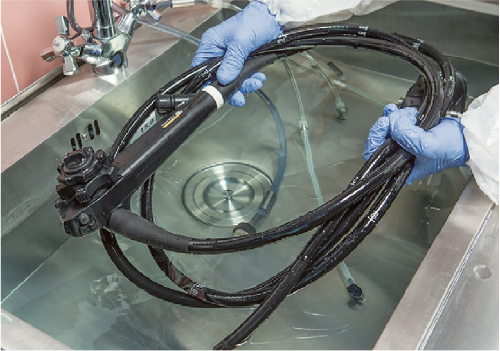 Analysis of the received materials showed that the reduction in the volume of pre-cleaning in 8.9% of endoscopy departments is always associated with time pressure. Refusal to perform a leakage test during manual cleaning is tolerated in nearly a third of EWD-equipped endoscopy departments and is associated with an underestimation of the importance of this step for endoscope damage prevention. Errors #numbered 5- 7 in table 1 also occur predominantly in endoscopy departments equipped with EWDs and are associated with the false belief that the EWD can completely replace manual cleaning.
| Table 1. The occurrence of critical errors during pre-cleaning and manual cleaning | ||
| No. | Error Description | Occurrence* |
| 1 | Refusal to flush the system of air or water channels and additional channels during pre-cleaning | 8.9% |
| 2 | Refusal to perform a leakage test during manual cleaning | 29.9% |
| 3 | Refusal to carry out manual cleaning before the reprocessing cycle in EWD | 1.7% |
| 4 | Skipping or reducing the number of brushing passes | 6.2% |
| 5 | Reducing the duration of the endoscope soaking in the detergent solution | 7.9% |
| 6 | Flushing with detergent solution can be skipped before the reprocessing cycle in EWD | 2.0% |
| 7 | Refusal to use alcohol for additional drying of endoscope channels before the reprocessing cycle in EWD | 7.2% |
|
*Respondents answered several different questions regarding endoscope reprocessing; therefore, the table only shows the occurrence of the error. |
||
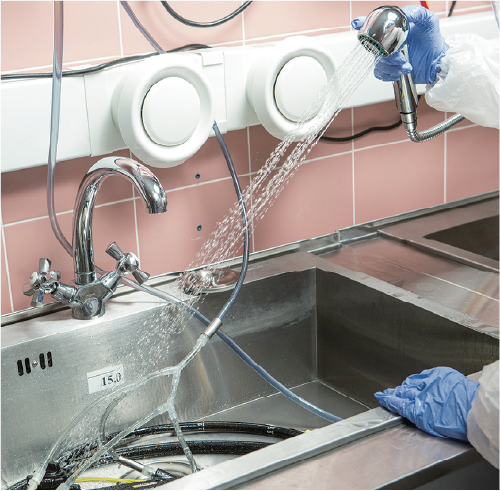
It is this false belief that sometimes allows brushing to be skipped or the number of brushing passes to be reduced. There is insufficient provision of disposable brushes for reprocessing in most endoscopy departments; therefore, reusable brushes are used in 72.0% of the surveyed hospitals.
Manual final rinsing of gastrointestinal (GI) endoscopes is carried out with tap water in all questioned endoscopy departments. Antibacterial tap water treatment systems (0.2 micron water filters) are not used in 11.7% of EWDs. In Russia, 70% alcohol is used for additional drying of endoscope canals. This requirement is fulfilled by 92.8% of endoscopy departments. At the moment, this measure cannot be refused due to the low provision of storage cabinets with a drying function (25.4%), insufficient provision of EWDs, and the use of EWDs with unvalidated detergents and HLD solutions.
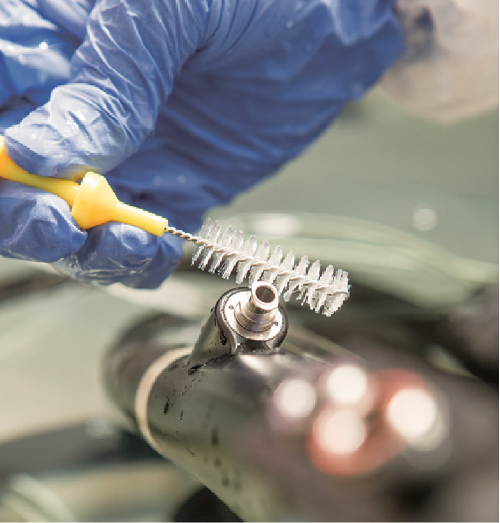
Quality control of endoscope reprocessing is carried out by visual, instrumental, and microbiological methods with the frequency established by the Guidelines. Among 460 respondents who answered a relevant set of questions, 104 (22.6%) do not carry out quality control of manual cleaning, and 8 (1.7%) carry it out with a lower frequency. Among the main reasons for not fulfilling this requirement, the respondents named a lack of effective tests or insufficient information about them (57.6%), as well as a lack of time (29.6%). Microbiological control of the effectiveness of the endoscope reprocessing cycles is not arranged in 56 (12.7%), and is arranged at a frequency of less than four times a year in 82 (17.9%) of the 460 surveyed departments. The main reasons are the high cost of microbiological research (70.5%) and the lack of skills in sampling (29.5%).
Of the samples taken, 4.4% do not meet the efficiency criteria. Microbiological control of the efficiency of the EWD self-disinfection cycle was arranged in 223 (74.3%) of 300 medical facilities equipped with EWDs. The reasons for the rejection of microbiological monitoring of the effectiveness of self-disinfection EWDs are similar to the reasons for the rejection of microbiological monitoring of the effectiveness of the endoscope reprocessing cycle.
In 84.4% of the endoscopy departments surveyed, all or some of the nurses completed advanced training in endoscope reprocessing and HAI prevention.
Conclusion
The 2019 survey allowed the identification of the main risk factors for patient infection associated with the reprocessing of flexible endoscopes and the development of corrective measures that were included in the new Guidelines and a draft of new practical policies. It should be added that respondents representing the endoscopy departments of leading clinics, in response to a question about the main routes toward increasing the epidemiological safety of endoscopic examinations, gave the following answers:
- Improvement of equipment for endoscopy departments, such as EWDs and drying cabinets (76.7%)
- Continuing education of medical personnel on epidemiological safety issues (68.2%)
- Increasing the number and renewal of endoscopes, and providing a sufficient number of disposable instruments and personal protective equipment (PPE) (46.4%)
-
Publication Date:March 04, 2023
-
Category:MDR
HosCom International 2023 Vol. 1
