


All Three SARAYA Rapid Freezer Models Earn 5-Star Freezing Performance Certification

How fast does a commercial freezer really freeze? Until now, buyers had to compare figures that each manufacturer measured in its own way. A new certification program in Japan puts every machine through the same test, and all three models of SARAYA's Rapid Freezer have passed with the highest rating.
In September 2026, the Rapid Freezer SF-5, SF-10 and SF-20 were certified under the Freezing Equipment Performance Certification program run by FFTech, a Japanese association that promotes food freezing technology. All three models also earned five stars, the top grade, in FFTech's Freezing Power rating.
FFTech launched the program in March 2026 and issued its first certificates on September 1, 2026. So far, five models from three companies have been certified. FFTech describes it as the world's first program to measure and compare the freezing capacity of commercial freezing equipment under unified, science-based conditions.*
Instead of real food, each test uses a standard test package that freezes the way food does. The machine is loaded to its standard load, so results reflect real working conditions. An independent committee chaired by Professor Manabu Watanabe of Tokyo University of Marine Science and Technology oversees the program.
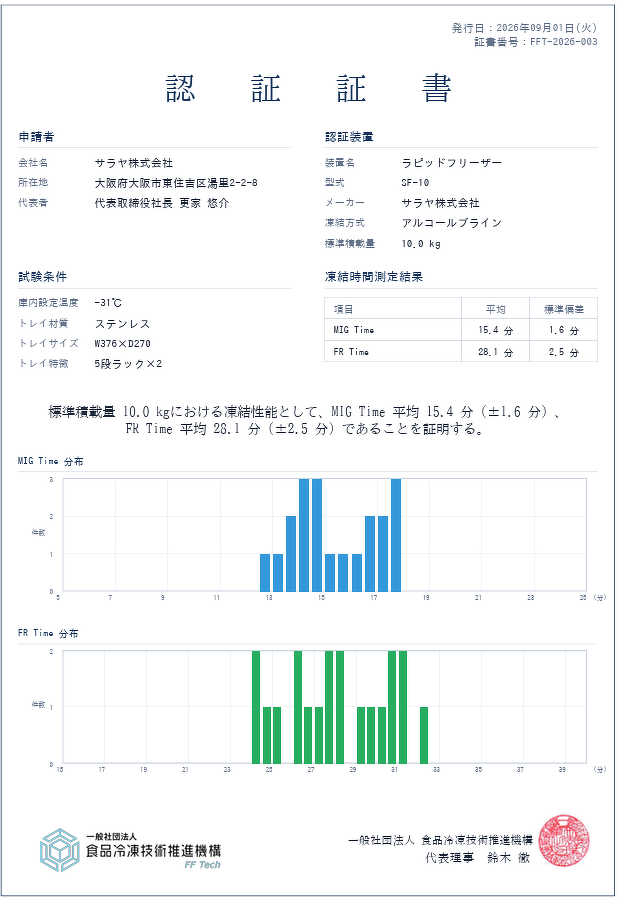
Each certificate reports four main figures:
- Standard load: the amount of food the manufacturer sets for one freezing run. MIG Time and FR Time should always be read with it.
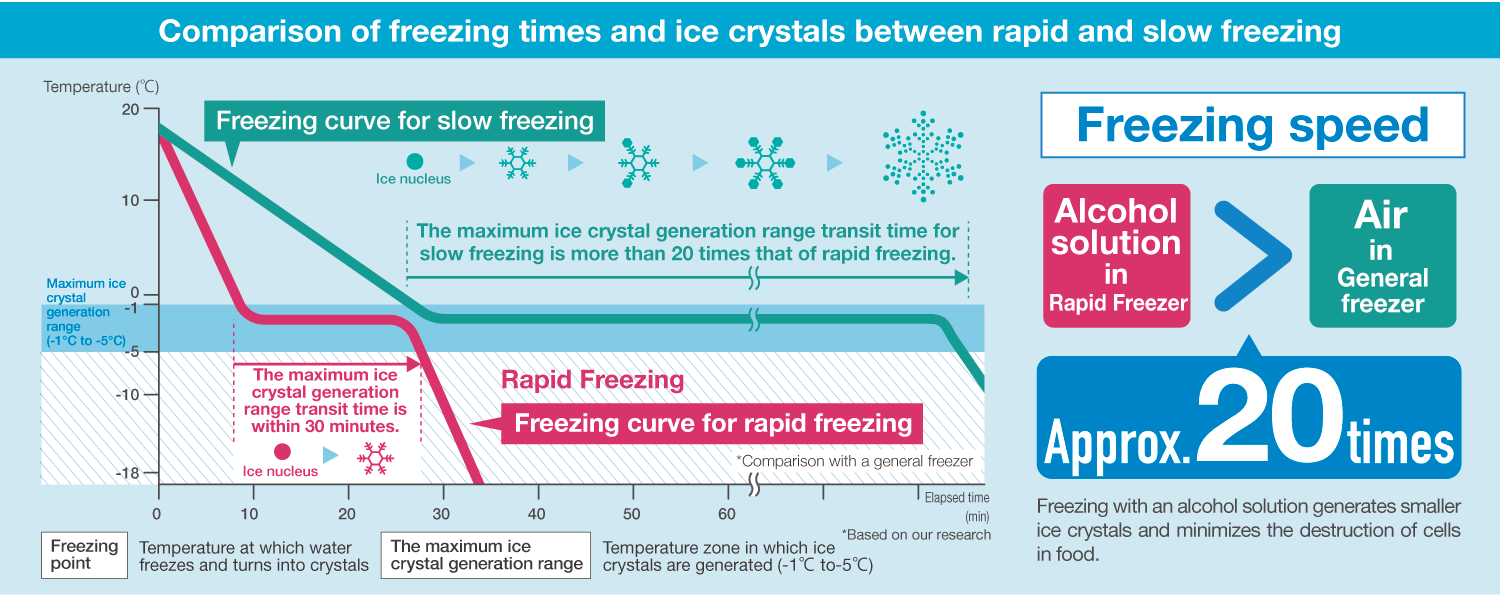
- MIG Time (Maximum Ice Growth Time): how long the center of the test package takes to pass through the temperature zone where most ice crystals form (about -1°C to -5°C). The shorter this stage, the smaller the ice crystals, which helps food keep its texture and flavor after thawing.
- FR Time (Freezing Time): how long the center takes to cool from 10°C to -15°C.
- Standard deviation: how evenly the machine freezes across its chamber.
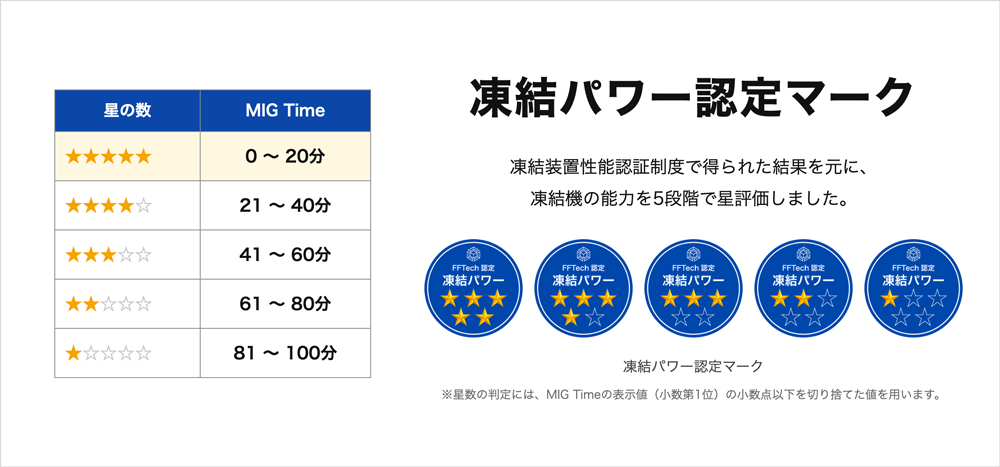
The Freezing Power star rating is based on MIG Time. A MIG Time of 20 minutes or less earns five stars. Each additional 20 minutes drops the rating by one star, down to one star for 81 to 100 minutes. FFTech notes that these figures show freezing speed only, not the overall quality of a machine.
Rapid Freezer Results
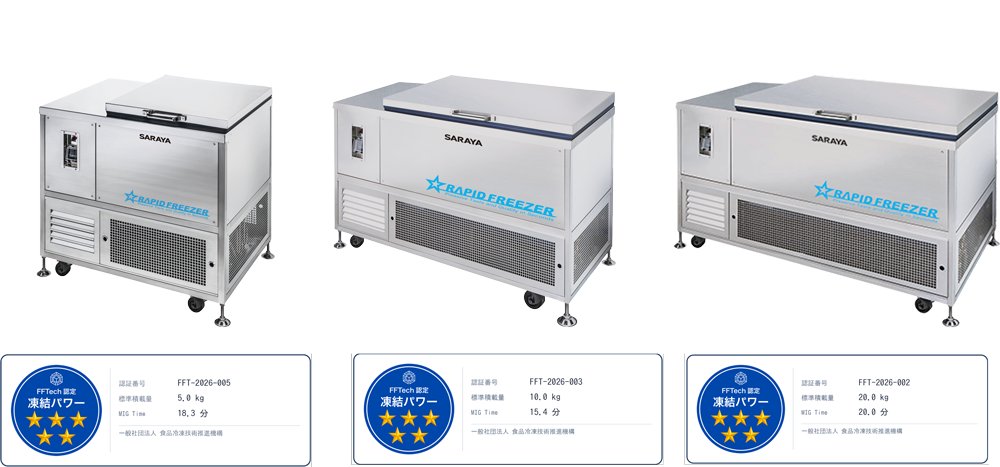
| Model | Certification No. | Standard load | MIG Time | Freezing Power |
|---|---|---|---|---|
| SF-5 | FFT-2026-005 | 5.0 kg | 18.3 min | ★★★★★ |
| SF-10 | FFT-2026-003 | 10.0 kg | 15.4 min | ★★★★★ |
| SF-20 | FFT-2026-002 | 20.0 kg | 20.0 min | ★★★★★ |
The Rapid Freezer is an alcohol brine freezer, where packed food is immersed in a special solution chilled to about -30°C. Because liquids conduct heat about 20 times better than air, food freezes much faster than in a conventional air-blast freezer. Faster freezing means less drip loss and better texture, taste and appearance after thawing.
For food businesses, that opens up practical options. They can buy seasonal ingredients in bulk for year-round use, prepare food in quiet periods ahead of peak demand, and ship products farther to reach new markets.
SARAYA will keep improving freezing technology that helps reduce food loss and bring better-quality food to more people, contributing to sanitation, the environment and health around the world.
To learn more about the Rapid Freezer or ask about availability in your region, contact us.